



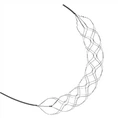
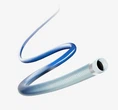
1. The safe and effective placement of the microcatheter is the primary condition for embolization of AVM. To accurately and selectively send the microcatheter into the blood supply artery to the malformation mass, two technologies can be applied: 1. Blood flow guidance technology; 2. Micro guidewire guidance technology.
2. Blood flow guidance technology: It is suitable for flow directed microcatheter to be in place, and the arterial blood flow is used to push the soft floating microcatheter head along the path artery and through the blood supply artery to reach the malformation vascular mass or target position. During the advancement of the microcatheter, the direction of the head of the microcatheter can be changed by injecting contrast agent or saline to enter the target blood vessel.
3. Micro guidewire guidance technology: Use the matching micro guidewire to guide the microcatheter forward, and at the same time increase the support force of the microcatheter to guide the microcatheter to the target position. During the micro guidewire guidance process, gentle operation is required to prevent the micro guidewire from puncturing the path blood vessel.
In short, according to the AVM embolization treatment strategy and the path blood vessels, you can choose a floating microcatheter or micro-guidewire guided microcatheter that is compatible with the above two technologies. After the microcatheter is in place, it is necessary to repeatedly perform multi-angle super-selective angiography to avoid embolizing normal blood vessels as much as possible.
Operation steps and technical points for using liquid embolic agent
1. Like other glue embolization, all embolization methods must be preceded by super-selective angiography to carefully analyze the AVM vascular structure and hemodynamic characteristics.
2. Selection of embolization supply arteries: Select the path blood vessels according to the individualized strategy of intravascular interventional treatment. Generally speaking, various embolization materials are first used to eliminate risk factors such as bleeding or high flow; when there is no obvious dangerous structure, the main blood supply responsible artery is selected for embolization.
3. Position of the microcatheter: The microcatheter should enter but not penetrate the abnormal blood vessel mass as far as possible. If it is far away from the abnormal blood vessel mass, it will not be able to embolize the abnormal blood vessel mass satisfactorily, and it is easy to embolize the normal arterial branch blood vessels. If it is too deep, it is easy to cause the drainage vein to be embolized prematurely.
4. Choose a good working angle: During the injection process, it is required to always be able to see the position of the microcatheter head end clearly, so as to timely detect possible reflux, control the reflux length, and decide when to remove the microcatheter. And be able to observe the diffusion of glue to prevent important branch blood vessels from being accidentally embolized.
5. Choose appropriate superselective angiography images as intraoperative embolization reference: The reference image should include the feeding artery, abnormal blood vessel mass and the main drainage vein in the area.
6. Requirements for injection speed: When the injection of glue begins to replace DMSO, it is recommended to inject slowly to prevent the rapid injection of DMSO from causing changes in heart rate. When liquid embolic agent diffuses into the abnormal vascular mass, the speed of liquid embolic agent injection is controlled according to the selected microcatheter, vascular diameter, hemodynamics and the diffusion of glue. Especially when diffusing in small blood vessels, the push injection speed should be slower.
7. Embolzation and push injection technique: When injecting liquid embolic agent, it is required to create a "block" around the catheter tip to "block the blood flow" so that liquid embolic agent can diffuse forward. Using the "waiting" technique to cause a pressure gradient change can help improve the penetration of liquid embolic agent.
8. Waiting time and pressure during re-injection: It is generally believed that the "waiting time" is less than 2 minutes to prevent liquid embolic agent from precipitating in the microcatheter due to too long a wait, causing blockage.
9. Microcatheter withdrawal: There are two techniques for microcatheter withdrawal. One is rapid withdrawal, which uses a quick swing of the wrist to withdraw the microcatheter. This technique is rarely used and can easily cause small blood vessels to tear and bleed. The other is slow withdrawal, which is the commonly used method of withdrawal. After releasing the tension of the microcatheter, the micro catheter is withdrawn and the tension is maintained. After a short wait, the microcatheter is continued to be withdrawn (usually in centimeters) until the microcatheter is pulled out. When the tension is large or the blood vessel displacement is very obvious, the catheter should not be pulled out forcefully to avoid bleeding complications. When withdrawal is indeed difficult, you can try to withdraw the microcatheter or inject a small amount of DMSO solvent to dilute the EVOH at the tip of the microcatheter.