



Guiding Catheter
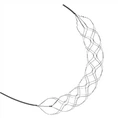
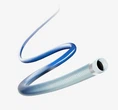
The guiding catheter is used to provide support for the distal access. The ideal guiding catheter should not recoil into the aorta when advanced and needs to provide a stable support platform. Therefore, stiffness is critical for guide catheters. Stainless steel wire is five times harder than Nitinol, and the braided design provides significantly greater stiffness than coils. Therefore, design manufacturers often prefer stainless steel braid. In addition, harder outer tubes are usually used, such as nylon and high-hardness PEBA.
Microcatheter
Reaching distal small-bore vessels requires advanced engineering applications and complex design. Manufacturers often employ hybrid braid/coil designs with varying spacing and PPI values along the microcatheter. Typically, a stainless steel braid is used proximally to provide support and torsion capabilities. A tight coil is preferred distally to allow for better device tracking through tortuous vascular anatomy. In addition, using a softer polymer(such as low-stiffness PEBA) outer tube can prevent vascular damage.
Diagnostic Catheter
Diagnostic catheters are primarily used for selective proximal vascular cannulation. Therefore, twistability and precise control are essential for diagnostic catheters. Because torsibility and stiffness are closely related, manufacturers often prefer stiffer materials in designs, such as stainless steel braiding and nylon outer sheaths. However, torsibility is accompanied by increased stiffness, making its use with diagnostic catheters in distal tortuous vasculature very difficult.
Distal Access and Aspiration Catheters
The aspiration flow rate increases with the fourth power of the inner diameter. Therefore, thin walls and larger inner diameters are ideal aspiration catheter designs. However, advancing large-bore catheters through tortuous intracranial vessels is certainly not without risks. Therefore, flexibility is critical in the design of large-bore distal access or aspiration catheters. On the one hand, while providing a certain degree of flexibility, the skeleton of the catheter should also be strong enough to prevent the catheter from collapsing under negative pressure. Additionally, there are challenges in maintaining pushability in the softer distal portion of these catheters. Therefore, aspiration catheter design is one of the most complex areas in medical device engineering.
Manufacturers almost always use large-bore catheters in a hybrid braided and coiled design. Like the microcatheter, the braided technology is used almost exclusively for support, with the distal coil used for better instrument trackability and cuff strength (not collapsing under negative pressure). However, in contrast to microcatheter designs, stainless steel wires do not dominate. Nitinol wires offer better shape memory and kink resistance, potentially reducing aortic recoil and providing better pushability around vessel curvatures. Therefore, stainless steel wire and nitinol wire are equally popular in large diameter catheter designs. Additionally, softer coatings are better suited for larger diameter catheters, and nearly every manufacturer uses PEBA polymers that are more flexible.