



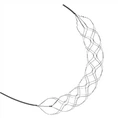
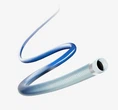
After several iterations of thrombectomy stent retriever, the safety and efficacy of thrombectomy stents have continued to improve. Since then a competing technique has emerged: direct aspiration. Known as ADAPT (A Direct Aspiration first Pass Technique), the technique relies on a reinforced large inner lumen catheter that can be delivered to the thrombus, which can then be directly aspirated. An early study reported that ADAPT alone resulted in a 78% recanalization rate. The COMPASS trial randomized ADAPT and stent retrieval as first-line techniques for large-vessel occlusive stroke, showed that both techniques were equally likely to achieve good outcomes. Patients in ADAPT group for first recanalization was achieved in 57%, while patients in the stent group was 51%. In addition, stent retriever combing with aspiration catheter for mechanical thrombectomy was used in 85% of patients in the stent group.
Therefore, the new stent retrieval device may be suitable for use with direct aspiration. It is also known as the Solumbra technique. The third-generation stents did improve angiographic outcomes, as shown in randomized studies of 3D revascularization devices. The success of existing devices has set a high bar for the development of new stents. The design of new devices must prioritize the convenience and timeliness of delivery to the target vessel, as well as improving the first-time recanalization rate.
Direct comparisons of different second and third generation stents in in vitro and in vivo animal models help clarify how aspects of stent design can contribute to improved clinical performance and provide directions for further development. One study compared some foreign commonly used stents. Devices were compared by two mechanical and two functional tests.
The mechanical tests used were the plate compression and pull-up traction tests. These tests show that full-section devices like tubular stents cannot be directly compared to incomplete-section devices like sheet-like stents. The radial stress of most tested devices decreased significantly when the stent was moved from 1.5mm to 3.5mm.
Functional testing of the device included a retrieval test, which tested its anterior and posterior vessel apposition when the device was retrieved in a tortuous simulated vessel. Some device showed consistent vessel adherence, the other devices showed elongation at sharp bends, and one other device in the test (3x20 mm) completely lost adherence. Thrombectomy trials were performed using simulated red (clumped red blood cells) and white (fibrin-based) thrombi of different sizes. All test devices showed that the large white thrombus could not be fitted and displaced, while the medium and small white thrombus had different degrees of fitted and displaced. The red thrombus is completely fitted, but fragmentation has occurred obviously, and there is a possibility of distal embolism.
The future development trend of thrombectomy devices will continue to aim at improving the FPE rate, and follow the development trend and new frontiers of thrombectomy indications. The most important of these is distal or mid-vascular thrombectomy. This would require a smaller diameter, possibly open-loop stent design, around the MCA knee, and more tortuous and smaller diameter M2 and M3 segments that could provide mechanical traction and radial force.
Future directions for this type of research must compare stents of similar size and classification with each other and possibly also investigate direct aspiration as an adjunct to stent retriever use in order to better quantify the additive effect of the Solumbra technique. The stent retriever in most studies have been updated by the suppliers, so it is also valuable to update the literature with newer evidence. Comparative animal studies of stents are also valuable to clinicians.