



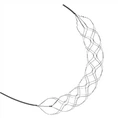

The BADDASS technique is a combined thrombectomy technique proposed in 2019. That is, balloon guide with large bore distal access catheter with dual aspiration with stent-retriever as standard approach for thrombectomy. The standard operation of BADDASS technology requires that the thrombectomy stent and the intermediate catheter be withdrawn as a whole, which weakens the advantages of all materials in BADDASS technology. For the soft thrombus with small load, when the stent reaches the big blood vessel during the withdrawal process, the thrombus embedded in the stent is easy to fall off due to the expansion of the stent retriever and the tension of the guide wire of the stent. For these patients, it may be more appropriate to use the thrombectomy stent to pull out from the intermediate catheter, followed by in aspiration of the intermediate catheter at the same position. If the thrombus has been taken out of the stent, the thrombus fragments cut off by the tip of the catheter can be extracted by continuous aspiration of the intermediate catheter. If the thrombus has not been taken out, the intermediate catheter continues to the thrombus, which is equivalent to continuous stent and aspiration thrombectomy. In addition, the BADDASS technique is more cumbersome than the standard SWIM technique. Some patients may delay the recovery of distal perfusion. And the entire thrombectomy system is expensive, which is a expensive way for some patients. However, for complex patients with heavy thrombus burden, BADDASS technology may better reflect its own advantages.
The BADDASS technique involves several components, including a microcatheter, balloon guide, and stent-retriever. The first step is to advance a microcatheter to the site of the clot, using real-time imaging guidance. Once the microcatheter is in place, a balloon guide is then advanced over the microcatheter. The balloon guide is inflated to prevent blood flow and create a stable platform for the next step, which involves advancing a large bore distal access catheter.
The large bore catheter is designed to provide dual aspiration, which improves the ability to remove clots from the target vessel. After the catheter is in position, a stent retriever is advanced through the catheter and placed across the clot. The stent-retriever then captures the clot, and the balloon guide is deflated, allowing blood flow to resume.
One of the key advantages of the BADDASS technique is that it allows for a more complete and efficient removal of clots. This is important because incomplete removal of clots can lead to reperfusion injury, which can worsen patient outcomes. In addition, the use of the balloon guide and dual aspiration catheter reduces the risk of distal embolization, which can block smaller blood vessels in the brain and cause additional damage.
Another advantage of the BADDASS technique is that it can be used as a standard approach in patients with acute stroke. This means that it can be implemented rapidly by trained healthcare providers without the need for additional specialized training or equipment. This allows for faster and more efficient treatment, which can have a significant impact on patient outcomes.