



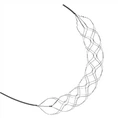

Stent-assisted embolization has become the first choice for the treatment of ruptured intracranial aneurysms. Related studies have confirmed that stent-assisted embolization can significantly improve the prognosis and recurrence rate of patients with ruptured intracranial aneurysms. Compared with simple coil intratumor embolization, implantation of an auxiliary stent can reduce the probability of coil escape, and the blood flow guidance function of the auxiliary stent itself can induce thrombosis in the aneurysm, achieving the purpose of dense embolization of the tumor.
Common types of auxiliary stents include laser engraved stents and braided stents. Laser engraved stents have good flexibility, can pass through curved blood vessel segments more smoothly, are not easily deformed, and the closed-loop design gives them good stability and a more obvious effect in changing the direction of blood flow. However, its disadvantage is that the closed-loop design makes it unable to better adapt to the poor adhesion of curved blood vessel segments. Compared with laser engraved stents, braided stents have higher void density, and their metal coverage is generally 11%-23%. The high metal coverage gives them a good long-term aneurysm embolization densification effect.
Stent-assisted coil embolization has a high rate of complete occlusion of aneurysm aneurysms. The patency of the parent artery can be maintained during coil packing. There is basically no coil escape after packing, and the probability of postoperative aneurysm recurrence can be reduced. However, there are perioperative complications such as bleeding and ischemia, and the use of dual-antibody drugs conflicts with the treatment of bleeding complications.
In summary, stent-assisted coil embolization in the treatment of ruptured intracranial aneurysms can achieve good therapeutic effects, but there are still many problems that need to be addressed when using the technology of stent-assisted embolization, such as bleeding and thrombosis. This not only requires extremely high operational skills of clinicians, but also requires the advancement of related material science. In subsequent clinical studies, scholars need to continue to explore the mechanism of related complications in stent-assisted embolization in the treatment of ruptured intracranial aneurysms, clarify the timing of surgery and the principles of dual-antibody drug treatment, and provide theoretical support for patients' clinical treatment, complication prevention, etc.