



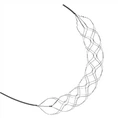
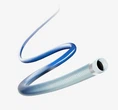
Addressing the pain points in neurointerventional clinical practice, the Distal access catheter has achieved multiple breakthroughs in structural design and performance parameters, with each technology precisely matching clinical needs:
1. Ultra-flexible distal end + gradient support: Balancing accessibility and stability
• Ultra-flexible distal end design: The distal end utilizes medical-grade ultra-flexible polymer material with a bending radius as low as the clinical critical threshold. Combined with excellent tracking performance, it can easily traverse complex vascular pathways such as the carotid siphon segment and basilar artery tortuosity, directly reaching distal lesions such as the M3 segment of the middle cerebral artery and the P3 segment of the vertebrobasilar artery, minimizing mechanical stimulation to the vessel wall and reducing the risk of dissection and perforation.
• Coil + braided composite structure: An innovative "coil + braided" composite reinforcement structure creates a gradient stiffness distribution-proximal reinforcement provides strong support, effectively resisting the reaction force from vascular tortuosity and preventing device displacement or "retraction"; the mid-section gradually transitions to a flexible structure from the distal end, balancing pushing flexibility with lumen stability, achieving the dual advantages of "rigid support without compromise and flexible passage without jamming."
2. 0.088" Extra-Large Lumen: Redefining Access Delivery Efficiency
Addressing the pain points of "device compatibility" and "thrombus removal" in procedures such as mechanical thrombectomy and aneurysm embolization, we introduce an extra-large 0.088-inch (approximately 2.24mm) inner diameter model. The cross-sectional area of the lumen is significantly increased compared to conventional catheters (e.g., 54% larger than a 0.071-inch catheter), bringing three core benefits:
• Highly Efficient Thrombus Removal: Supports "direct aspiration" technology. The extra-large lumen allows for complete ingestion of the thrombus, reducing the risk of thrombus fragmentation, improving the first-pass effect (FPE), and shortening the recanalization time;
•Distal Flow Reversal: The larger lumen volume enables more effective distal flow reversal, reducing the risk of embolic complications;
•Multi-Device Compatibility: Easily accommodates multiple treatment devices such as thrombectomy stents, microcatheters, and coils simultaneously, eliminating the need for repeated access changes and improving surgical efficiency.
3. Dedicated Fit for the Radial Approach: The Ideal Choice for Minimally Invasive Treatment
The 6F-R series models (such as 6F-95R, 6F-105R, etc.) are specifically designed for the radial artery approach, with an effective length covering 95-125cm and an inner diameter of 0.071 inches. They perfectly match the 6F radial artery sheath, solving the traditional problems of insufficient access length and inadequate support associated with the radial approach:
• Reduced Trauma and Complications: The radial approach avoids the risks of puncture-related bleeding and hematoma associated with the femoral artery approach, making it particularly suitable for obese patients, those undergoing anticoagulation therapy, or those with poor vascular conditions;
• Shorter Hospital Stay: The minimally invasive nature allows for faster postoperative recovery, with an average hospital stay more than 30% shorter than the femoral approach, improving the patient experience and reducing hospital bed occupancy costs;
•Operational Flexibility: Compatible with commonly used 6F guiding catheters in neurointerventions, allowing stable access to distal intracranial lesions and providing reliable access support for transradial neurointerventional surgery.
4. Versatile Compatibility: Covering Multiple Types of Neurointerventional Surgery
A comprehensive product range, encompassing various outer diameters including 5F, 6F, and 8F, with effective lengths ranging from 95cm to 132cm, adaptable to different access routes and lesion sites:
• 5F Series (e.g., 5F-105/115/125/132): Inner diameter 0.056 inches, compatible with 6F guiding catheters, suitable for distal small vessel lesions (e.g., M2-M3 segment thrombosis, microaneurysms);
•6F-S Series (e.g., 6F-115S/125S/132S): Inner diameter 0.073 inches, compatible with 6F long sheaths, 8F guiding catheters, or balloon guiding catheters, suitable for complex cases such as moderate to severe stenosis and wide-necked aneurysms;
• 8F Series (e.g., 8F-95/105/115): Inner diameter 0.088 inches, compatible with 8F... The sheath is designed specifically for mechanical thrombectomy and removal of large thrombi, making it the preferred device for the treatment of acute ischemic stroke.