



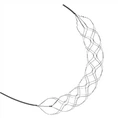

Fundamentals of Stent Retrieval
The principle of modern stent retrieval is that under the guidance of imaging technology, the doctor passes a guide wire through the thrombus, inserts a microcatheter, and advances stent retrieval into the microcatheter, and then withdraws the catheter. The memory alloy stent will automatically release and open. The stent struts are combined with the thrombus to embed the thrombus into the mesh structure of the stent. The thrombus and stent are taken out of the body together, which completes a thrombus removal operation. Anouchska S. A. Autar and other members conducted micro-CT, histopathological and electron microscope scanning observations on the stent and thrombus samples taken from the whole body of the patient in the MR CLEAN registration study, showing the basic form of the interaction between the stent struts and the thrombus. Its mode of action is divided into "mechanical type" and "adhesive type". The integration of stent struts and thrombus is the basic principle of the action of all thrombus stent retriever.
Advances in The Design of Thrombectomy Stent Retriever
Using nickel-titanium alloy material as the carrier, researchers can use finite element analysis to simulate the performance of the thrombectomy stent retriever, the radial support force of the stent retrieval, the integration ability of the thrombus and the stent, and the friction force of the stent moving in the blood vessel . With the emergence of new animal models of large vessel thrombosis occlusion, the research and development of thrombectomy stent retriever is more convenient and efficient. With the continuous improvement of the performance of thrombectomy stent retriever, a series of new thrombectomy stent retrievers have emerged, such as the 3mm diameter stent for medium sized vessels(MeVO) for thrombectomy, which can be delivered in a 0.017'' microcatheter system. It can improve the safety of M2 or M3. Longer thrombectomy stent retrieval(40mm) has been reported in the literature that can improve thrombectomy efficiency.
Evolution of Stent Retrieval Device Technology
With the advancement of science and technology, the combination of various equipment and devices, the technology of thrombectomy stent retriever is gradually diversified. These techniques include aspiration combined with thrombectomy (Solumbra), stent retriever-assisted vacuum locking aspiration(SAVE) technique, large inner diameter balloon catheter distal access catheter dual suction stent retriever as standard (Badass) approach, aspiration thrombectomy technique (ARTS), proximal balloon thrombectomy (ASAP) to retract the stent into the aspiration catheter or proximal balloon occlusion and direct thrombus aspiration during stent retrieval(PROTECT-PLUS ), DAC catheter advancement thrombectomy stent (Advancing the DAC over the Stent Retriever, ADVANCE) technology. These thrombectomy techniques all involved the combination of auxiliary devices such as aspiration catheters and balloon-guided catheters, and all reported higher reperfusion rates, higher first-time recanalization rates, lower number of attempts, and/or Lower rate of distal embolism. In addition, there are double stent techniques for difficult thrombectomy, such as double stent mechanical thrombectomy and cross-over double stent thrombectomy. With the evolution of access products and the emergence of vascular sheaths with excellent performance and strong passability, thrombectomy via radial artery access becomes possible. Mechanical thrombectomy via a transcarotid approach improves the success rate of thrombectomy.
Development of Stent Retrieval in Acute Ischemic Stroke
Following the study and meta-analysis of five major clinical trials, as well as the DAWN study and the Deffuse3 study, it has been shown that early endovascular stent thrombectomy can improve the 90-day functional prognosis of patients with acute ischemic stroke without increasing the risk of intracranial hemorrhage and death. These strong evidences push the treatment of acute ischemic stroke into a new era: from standard intravenous thrombolysis to endovascular therapy based on intravenous thrombolysis. The guidelines of various countries followed up rapidly, and the guidelines for the acute treatment of ischemic stroke in the United States were updated. The Chinese Stroke Society organized domestic experts in this field to formulate the "Chinese Guidelines for Endovascular Therapy of Acute Ischemic Stroke 2018". As a new technology, stent retrieval can extend the treatment time window for patients with cerebral embolism to 24 hours. It has sufficient evidence and definite curative effect on the occlusion of large vessels in the anterior circulation such as internal carotid artery and middle cerebral artery. Expert consensus has been issued successively in Europe and the United States, recommending interventional thrombectomy stent retriever as the preferred treatment for acute ischemic stroke.
Stent retrieval has the advantages of rapid recanalization, lower hemorrhagic transformation rate and wider time window. The effectiveness of endovascular thrombectomy for acute ischemic stroke in the anterior circulation has been confirmed. For patients with acute vertebral-basilar artery occlusion, endovascular stent retriever thrombectomy has achieved certain results, but whether it is better than drug therapy, there is a lack of RCT Evidence-based medical evidence remains to be considered. The indications for stent retriever will continue to expand in the future, benefiting more AIS patients, and should become the direction of neurointerventional research.