


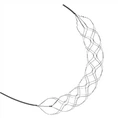
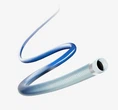
SWIM technology is a comprehensive technology based on stent retrieval as the cornerstone. It combined with intermediate catheter contact aspiration to realize the dual mechanisms of "stent grabbing" and "catheter aspiration". it has developed into a thrombectomy stent combined with an intermediate catheter thrombectomy technique after continuous evolution. It is a thrombectomy solution with Chinese characteristics that has been explored and screened out by Chinese thrombectomy doctors, taking into account the effect and cost. Those techniques that include balloon-guided catheters, aspiration catheters, etc. cannot be called SWIM techniques. There are two ways to remove the stent in the SWIM technique: one is that the thrombectomy stent is pulled out from the intermediate catheter, and then the intermediate catheter is aspirating. The other is that the thrombectomy stent is half withdraw into the head end of the intermediate catheter, and then withdrawn as a whole after being locked. . The first method can be attributed to a scheme that uses the intermediate catheter as the channel for thrombectomy, and the stent is retrieved after the height is in place + intermediate catheter is in situ aspiration, especially suitable for middle cerebral artery occlusion and other small embolic loads that can be pulled or suctioned into the intermediate catheter. The second method can be attributed to a thrombectomy technique with double fixed clamps combined with aspiration.
If SWIM technology is a Chinese characteristic, Solumbra technology is originated and promoted abroad. Like the SWIM technique, it has evolved into a thrombectomy technique that combines a thrombectomy stent with a aspiration catheter. The operation steps of the Solumbra technique are basically the same as those of the SWIM technique, but the details are different from the SWIM technique in which the intermediate catheter sticks to the thrombus, and the Solumbra technique in which the aspiration catheter does not touch the thrombus. In order to make up for the defect that the standard Solumbra technique does not directly contact the thrombus and achieve a better thrombus removal effect, the ARTS technique was further improved on it. The main improvement is that the proximal end needs to use a balloon guiding catheter and the aspiration catheter is close to the proximal end of the thrombus during aspiration. Unlike the standard Solumbra technique, the stent can be pulled back into the aspiration catheter and the aspiration catheter can be kept in situ for suction. The stent retrieval and aspiration catheter can also be withdrawn from the body as a whole at the same time. ARTS technology requires that the thrombectomy stent and aspiration catheter be withdrawn as a single system. There are many studies on Solumbra technology in foreign countries. Some studies have evaluated the effect of converting from ADAPT technology to Solumbra technology on the recanalization rate, and found that the conversion to Solumbra technology can increase the recanalization rate by 13.3%. And the larger the diameter of the occluded vessel, the more likely to use the conversion strategy. It also suggested patients with large diameter occluded vessels and large thrombus load, it may be more appropriate to directly prioritize the Solumbra technique.
ADAPT technique refers to the method of thrombectomy with direct aspiration as the preferred technique. In the early days, the standard operation of ADAPT was to suck a part of the thrombus with the aspiration catheter, and then withdraw the catheter and the thrombus as a whole. The advantage of aspiration is that it is only part of the thrombus is sucked by the catheter tip, and the main body of the thrombus that is outside may break off at any time. While the thrombus stent retriever fixes the whole thrombus. This also suggests that the thrombectomy stent is new effective way for endovascular therapy at that time, not aspiration. However, with the improvement and replacement of the aspiration catheter, the new aspiration catheter has a better ability for deployment and a larger lumen, which provides a stronger aspiration capacity. And most thrombus can be directly sucked out of the catheter from the original site. Its standard operating procedure has also been changed to the current aspiration catheter after contact with the thrombus and continuous negative pressure suction, and the thrombus is sucked out of the body until the negative pressure disappears and the blood flow restores. Unless the organized emboli with large volume and tough texture cannot be completely sucked out of the body from the catheter, this situation should be converted to the Solumbra technique as soon as possible. It may be more appropriate to remove the body as a whole through the double fixed clamp of the aspiration catheter with stent retriever.