



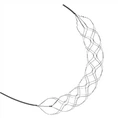

Mechanical thrombectomy is a minimally invasive procedure used to remove blood clots that cause acute ischemic stroke. Stent retriever combing with aspiration catheter is a new technique that has been introduced to improve the efficacy of mechanical thrombectomy. This technique involves the use of two devices: a stent retriever and an intracranial support aspiration catheter. The stent retriever is used to capture and remove the clot, while the intracranial support aspiration catheter provides a pathway for the removal of the clot and ensures complete revascularization of the occluded vessel.
The stent retriever is a self-expanding metallic stent that is designed to ensnare and retrieve the clot. The device is deployed across the clot, and then it is slowly withdrawn, together with the clot. The intracranial support aspiration catheter, on the other hand, acts as a support for the stent retriever and allows for the aspiration of the clot fragments that may have been left behind by the stent retriever. This technique has been found to have high success rates and has been associated with better functional outcomes in patients with acute ischemic stroke.
One of the main advantages of the stent retriever combing with aspiration catheter technique is its high efficacy in removing blood clots. Studies have shown that this technique has a success rate of more than 80%, which is significantly higher than the success rates of other mechanical thrombectomy techniques. This is because the combination of the stent retriever and the intracranial support aspiration catheter allows for complete removal of the clot, which reduces the risk of recurrence.
Another advantage of this technique is its safety profile. The stent retriever combing with aspiration catheter technique is minimally invasive and has a low risk of complications. It is also associated with shorter procedure times, which results in reduced hospitalization times for patients. This means that patients can recover faster and return to their normal activities sooner.
In addition to its high efficacy and safety profile, the stent retriever combing with intracranial support aspiration catheter technique is also cost-effective. The use of this technique has been found to be associated with lower healthcare costs, as it reduces the need for other interventions and decreases hospitalization times. This is particularly important in developing countries, where healthcare costs can be a major burden on patients and their families.
Overall, the stent retriever combing with aspiration catheter technique is a promising new approach to mechanical thrombectomy. It offers high efficacy, safety, and cost-effectiveness, and has the potential to revolutionize the treatment of acute ischemic stroke. As research into this technique continues, it is expected that its use will become more widespread and that it will become the standard of care for mechanical thrombectomy in the future.