



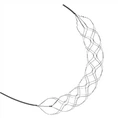

Thrombectomy for distal vascular occlusion requires more attention to details in terms of device selection and technical use. It is necessary to focus on considerations to ensure the safety of distal vessel thrombectomy as much as possible during thrombectomy procedure.
01 Microcatheter Micro Guide Wire Super Selection:
For stent thrombectomy in distal vessels, it is necessary to super select the microcatheter to the distal end of the occlusion first, especially for thrombus distal to M2. The microcatheter often needs to be superselected to M3, only in this way can the effective part of the stent be combined with the main body of the thrombus, while also accommodating the invalid distal end design of the stent retriever. Since the distal blood vessels are often weak in structure and tortuous.There may be displacement and damage of the distal blood vessels during the super selection process, which has certain risks. Therefore, the tension of entire microcatheter and micro guide wire must be released in time during the operation. The tip of the micro guide wire should be shaped into a small J shape as much as possible to avoid the whole system jumping forward and causing blood vessel perforation. For harder embolisms, there may be difficulties in passing the microcatheter microguide wire, repeated superselection may cause damage to blood vessels, and even cause blood vessel perforation, which requires us to be more gentle and cautious in operation..
02 Selection of Thrombectomy Stent Retriever:
Different designs of thrombectomy stent retrieval devices have different requirements on the position of the microcatheter. If there is a distal dead-end design, the microcatheter needs to be placed farther. If there is no dead-end design, the microcatheter does not have to be put in place too far. Considering the operational risks brought about by the superselection of the distal microcatheter and the dead end, it is recommended to use a thrombectomy stent without a dead end design for distal vessel occlusion.
03 Use for Intermediate Catheter :
Thrombectomy in distal vessels must be supported and assisted by an intermediate catheter. Due to the process of thrombectomy in the distal vessel, large vessel displacement will occur during the process of pulling back the thrombus stent retrieval. For example, if the M2 segment is occluded, the stent gets stuck in the thrombus during the stent retrieval process, the friction force between the thrombus retrieval stent and the vascular stent is relatively large, which will cause the displacement of the M2 and M1 vessels, resulting in the rupture of the vascular perforator and the M1 vessel. In the case of thrombectomy, we can see the S-shaped or wave-shaped displacement deformation of the proximal M1, which is caused by the displacement of the blood vessel during thrombectomy. At the same time, it will also cause the shear force of the M1 and internal carotid artery stent vessels, resulting in damage to the main blood vessels. Therefore, for distal vascular branches, the intermediate catheter can reach the M1 trunk or the distal end of M1 as a support point to reduce the vascular displacement of the retracted stent, thereby reducing the risk of vascular rupture during M2 thrombectomy.
04 Release Stent Retriever :
Longer stent retrievals do not necessarily have an advantage in distal vessel thrombus removal. The main reason is that the thrombus of vessel embolism is often shorter, which does not require a larger thrombus burden like proximal large vessel occlusion. Secondly, longer and larger thrombectomy stents will have resistance after release, resulting in significant vascular displacement. Therefore, it is not necessary to release all the stent retriever for longer stents. The release of the stent retrieval only requires the main body of the stent to cover the occlusion segment. , and the proximal part does not need to be fully released, and it is easier to reduce this resistance by choosing a smaller size stent.
05 Thrombectomy Stent Recovery:
The process of stent withdrawing requires close attention to the displacement and deformation of blood vessel. If there is a lot of resistance during the pull-back process, it is necessary to withdraw a part of the stent, and then try to pull back again until the resistance is controllable. It can be seen that the stent retriever can move slowly. In some cases, it may be difficult to retrieve the stent. At this time, the help of the intermediate catheter is needed to retrieve it, otherwise the forced retraction will cause a greater risk of vascular injury. Therefore, considering this risk, partial release of the thrombectomy stent is a relatively safe option.
Distal vascular thrombectomy is highly technical. Although most of the stent retrievals are easy to recanalize, there are still many challenges in some cases. we need to pay attention to the details of each operation from super selection micro guide to supporting of intermediate catheter, and we also need to operate more carefully, so as to reduce the risk of operation and enable patients to obtain recanalization safely.