

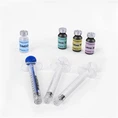
EVOH of Lava liquid embolic system is a copolymer with dimethyl sulfoxide (DMSO) solvent and a suspension of (radiopaque) micronized tantalum powder. When injected through the catheter and mixed with blood, the solvent is diluted, allowing the copolymer to settle into a sponge-like cast with a gel-like consistency. This causes blood vessels to clog more slowly than glue. The mixture has different viscosities (Lava12, 18 and 34), which can be selected according to needs. For example, Lava-18 will penetrate deep into the vascular bed into the foci of an AVM, while Lava-34 will settle more quickly and can be used in aneurysms with wider necks.
Since Lava liquid embolic agent is not sticky, there is much less risk of catheter clogging and getting stuck than with glue. Lava can be injected intermittently using the same catheter to assess progress by fluoroscopy. A small amount of polymer gel forms around the tip of the catheter, forming a skin at the interface of the mixture and blood. As more emboli are injected, it expands, creating a continuous rupture and re-peeling of the emboli, causing the emboli to flow like lava, providing a higher level of control than glue.
One of the properties unique to Lava liquid embolic agents is their ability to fill a target vessel and induce vascular occlusion by advancing with the blood flow and deep into the vascular bed to areas that a catheter or coil may not be able to reach. The precise mechanism by which occlusion occurs depends on the type of fluid embolism used. They also act independently of the patient's own coagulation process to induce vascular occlusion.