



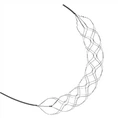

According to the neck-to-body ratio of aneurysms, intracranial aneurysms can be divided into wide-necked aneurysms and narrow-necked aneurysms.
A narrow-necked aneurysm generally refers to an aneurysm with an absolute diameter of less than 4 mm, or an aneurysm body-to-neck ratio greater than 1.5mm. For the treatment of narrow-necked aneurysms, endovascular coil embolization is generally used—the microcatheter is guided by a micro-guide wire to reach the aneurysm, and embolism such as coils is stuffed into the aneurysm until the aneurysm is completely healed. Blocking, promoting the occlusion of the cavity of the intracranial aneurysm, preventing blood from entering and further promoting the formation of internal thrombus to achieve the purpose of treatment.
A wide-necked aneurysm generally refers to an aneurysm with an absolute diameter greater than 4 mm, or an aneurysm body-to-neck ratio of less than 1.5mm. For wide-necked aneurysms, conventional treatment methods include craniotomy and clipping and coil embolization, which are difficult to treat, have high surgical risks, often cost a lot, and the incidence of postoperative complications and recurrence rates are very high.
Detachable coil system is one of the treatments for intracranial aneurysms. The intracranial coiling is a metal wire made of platinum. It is made into a variety of specifications with different diameters, lengths, and shapes due to the various needs of hemorrhagic neurological interventional surgery. It is soft in texture and connected to a metal push rod. In hemorrhagic embolization surgery, a microcatheter is inserted into the aneurysm cavity, and then the coil is pushed into the aneurysm cavity with a push rod. When the coil is stable in the aneurysm cavity, it is released by mechanical pulling. It is connectd with the push rod, and finally the coil achieves the purpose of embolizing blood vessels in the aneurysm cavity.